Heat capacity and heat of vaporisation
The amount of energy required for one gram of water to absorb in order for its temperature to increase by 1 °C is 4.2 J. This value is known as the specific heat capacity of water. Water has one of the highest specific heat capacities of all common substances. The higher the heat capacity of a substance, the more thermal energy it can store without undergoing a large change in temperature.
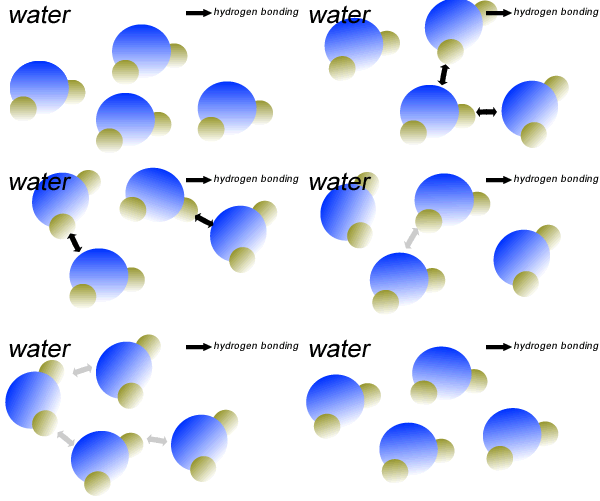
An increase in temperature increases the thermal energy available to particles and therefore increases their average kinetic energy. However, in water, the relatively strong hydrogen bonding between molecules results in strong intermolecular attractions. As a result, much of the absorbed energy is used to overcome these hydrogen bonds rather than to increase the kinetic energy of the molecules, leading to a smaller rise in temperature.
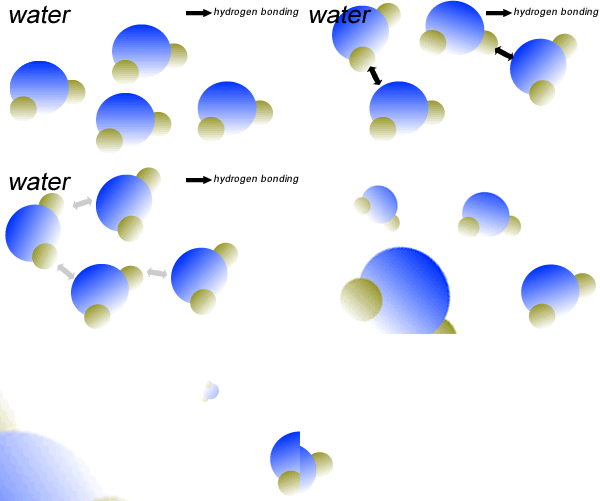
Again, due to hydrogen bonding, water has a very high heat of vaporisaiton. A great deal of energy is required to completely break these bonds and create a gaseous phase. Hence, for a moleucle of its size, it has a very high boiling temperature of 100oC.

Heat of vaporization is the amount of heat 1 g of a liquid must absorb for it to be converted to the gaseous state.
The fact that water has a very high heat of vaporisation makes it a very good coolant. This is the reason why we sweat in order to cool ourselves during exercise on hot days. Two things to note:
-
hydrogen bonds, like all bonds, must absorb heat in order to break, and heat is released when they form;
-
a great deal of heat energy (increase in temperature) is needed in order to disrupt the hydrogen bonds so that water molecules can move faster.
Water molecules on the surface of the skin absorb a relatively large amount of heat energy from the skin in order to disrupt the hydrogen bonds and vaporise. This tends to cool the surface of the skin.
Is heat released or absorbed when water vapour condenses into liquid? Explain

Explain why oil, shown on the right, heats up quicker than water. Discuss the intermolecular bonds that are present in oil.
Explain why ice cubes placed in a glass of water cools the water as they melt?
Why as water freezes is heat released?
How do the oceans moderate the surface temperature of the Earth?
Water molecules are held together by hydrogen bonds that continually break and reform. Since hydrogen bonds break by absorbing heat why does water not freeze?